
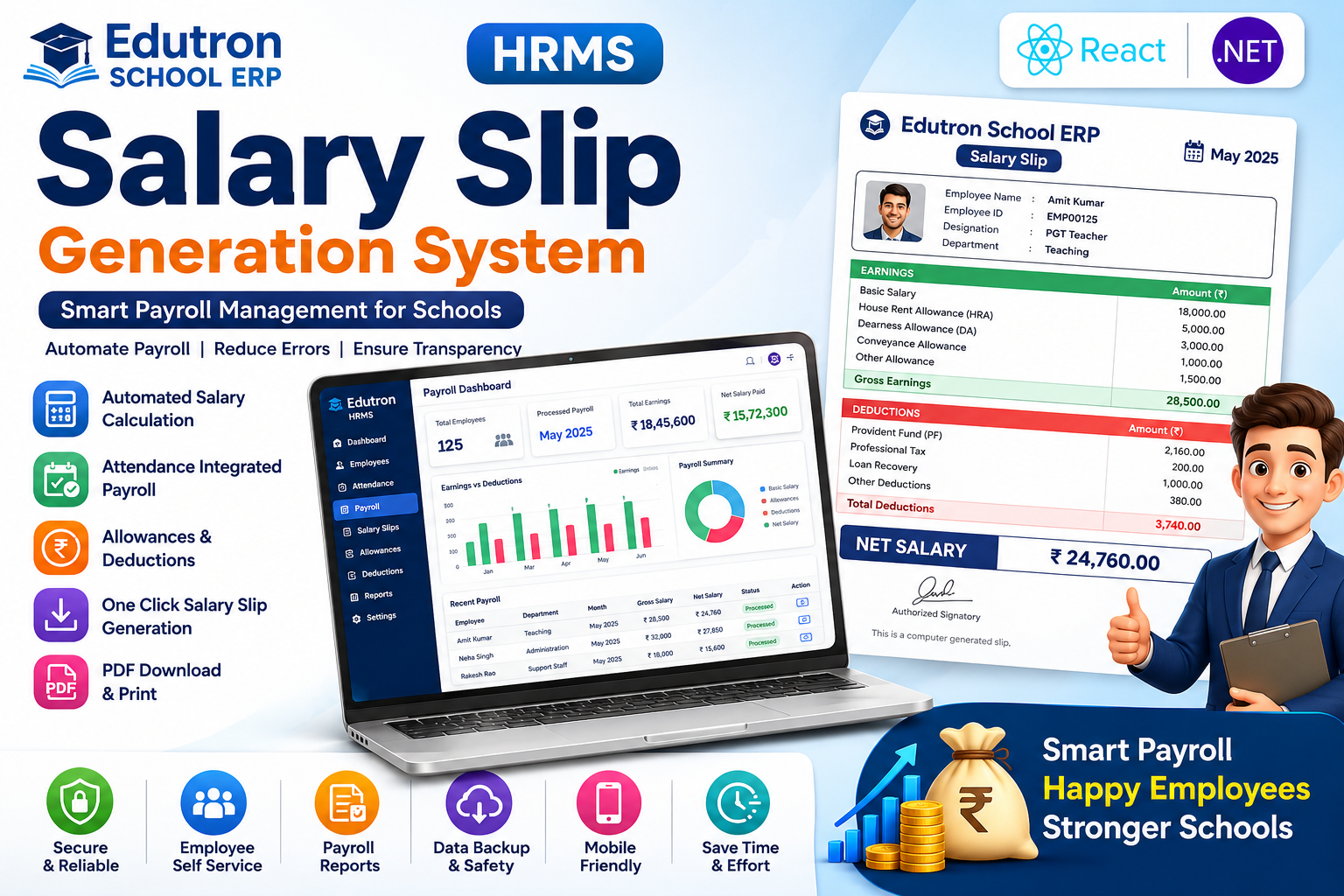
Salary Slip Generation System in Edutron School ERP HRMS (React & .NET)
Managing employee salaries efficiently is one of the most critical responsibilities of any educational institution. Schools often face challenges in calculating salaries, managing deductions, tracking attendance, and generating accurate salary slips for teachers and staff members. To address these challenges, Edutron School ERP HRMS offers a powerful Salary Slip Generation System built using modern React and .NET technologies.
The system automates payroll processing, reduces manual effort, eliminates calculation errors, and ensures timely salary distribution. Whether your institution has 20 employees or 500+, Edutron School ERP HRMS provides a scalable solution to streamline payroll operations.
Why Schools Need an Automated Salary Slip Generation System
Traditional payroll management methods involving spreadsheets and manual calculations often result in:
- Calculation errors in salary processing
- Delayed salary generation
- Difficulty tracking deductions and allowances
- Lack of transparency for employees
- Increased administrative workload
- Challenges in maintaining payroll records
An automated salary slip generation system eliminates these issues by integrating payroll management with attendance, leave records, and employee profiles.
Key Features of Edutron School ERP Salary Slip Generation System
1. Automated Salary Calculation
The HRMS automatically calculates salaries based on predefined salary structures, attendance records, leave balances, and applicable deductions.
- Basic Salary
- House Rent Allowance (HRA)
- Dearness Allowance (DA)
- Conveyance Allowance
- Special Allowances
- Overtime Payments
- Performance Incentives
2. Attendance-Based Payroll Processing
The payroll system is integrated with employee attendance management. Salary calculations automatically consider:
- Present days
- Absent days
- Paid leaves
- Half-day attendance
- Late arrivals
- Extra working hours
This ensures accurate salary computation without manual intervention.
3. Deduction Management
The system supports multiple deduction categories:
- Provident Fund (PF)
- Professional Tax
- Employee State Insurance (ESI)
- Loan Recovery
- Advance Salary Adjustments
- Other Custom Deductions
All deductions are automatically reflected in salary slips.
4. Custom Salary Structures
Schools can create different salary structures for:
- Teachers
- Administrative Staff
- Accountants
- Drivers
- Support Staff
- Management Personnel
This flexibility allows institutions to manage payroll according to their policies.
5. One-Click Salary Slip Generation
Administrators can generate salary slips for individual employees or entire departments with a single click. The system automatically prepares professional salary slips containing:
- Employee Details
- Salary Month
- Earnings Breakdown
- Deductions Breakdown
- Net Salary
- Payment Date
- Authorized Signatory Section
6. PDF Download and Printing
Generated salary slips can be:
- Downloaded as PDF
- Printed directly
- Archived digitally
- Shared through employee portals
7. Employee Self-Service Portal
Employees can securely log in to their portal and access:
- Current Salary Slip
- Previous Salary Records
- Payroll History
- Deduction Details
- Tax Information
This reduces dependency on HR staff for salary-related inquiries.
Technology Stack: React & .NET
Edutron School ERP HRMS is built using modern technologies to ensure performance, scalability, and security.
Frontend (React)
- Responsive User Interface
- Fast Page Loading
- Real-Time Data Updates
- Mobile-Friendly Design
- Interactive Payroll Dashboard
Backend (.NET)
- Secure API Architecture
- Role-Based Access Control
- Efficient Payroll Processing Engine
- Database Security
- High Performance and Scalability
Benefits for School Management
- Save administrative time
- Reduce payroll errors
- Improve employee satisfaction
- Ensure timely salary processing
- Maintain accurate financial records
- Simplify statutory compliance
- Enhance payroll transparency
Benefits for Employees
- Quick access to salary slips
- Transparent salary calculations
- Easy download of historical payroll records
- Reduced dependency on HR personnel
- Improved confidence in payroll accuracy
Security and Data Protection
Payroll data is highly sensitive. Edutron School ERP HRMS implements multiple security measures including:
- Role-Based Access Control
- Encrypted Data Storage
- Secure Authentication
- Audit Logs
- Regular Data Backups
- Controlled Payroll Access
These features ensure confidentiality and integrity of employee salary information.
Why Choose Edutron School ERP HRMS?
Edutron School ERP is designed specifically for educational institutions. Unlike generic payroll software, it integrates seamlessly with school operations including attendance, leave management, employee records, fee management, and accounting modules.
Schools across Bihar, Jharkhand, and other regions can benefit from a centralized HRMS platform that simplifies workforce management while improving operational efficiency.
Conclusion
The Salary Slip Generation System in Edutron School ERP HRMS offers a complete payroll automation solution for schools. By combining attendance tracking, payroll calculations, deduction management, and digital salary slip generation, the system helps educational institutions save time, reduce errors, and improve employee satisfaction.
If your school is still managing payroll manually, now is the perfect time to upgrade to a modern, automated HRMS solution with Edutron School ERP.
Book a Free Demo Today
Phone: 7870606162
Website: https://edutronschool.in