
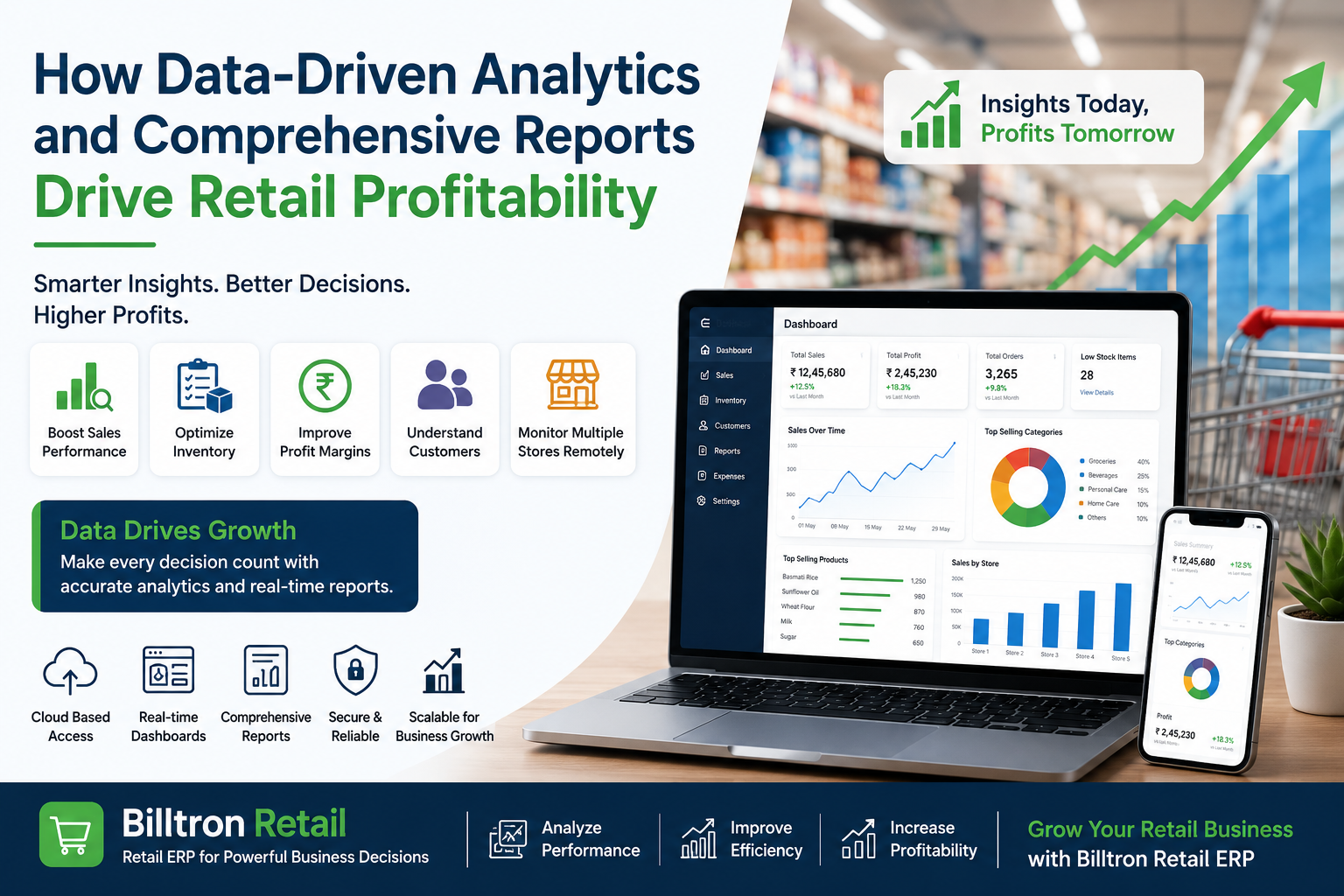
How Data-Driven Analytics and Comprehensive Reports Drive Retail Profitability
In today’s competitive retail market, success is no longer driven by intuition alone. Retail businesses that rely on accurate data and actionable insights are outperforming competitors by improving efficiency, reducing operational waste, and maximizing profitability. Whether you manage a single retail outlet or multiple branches, data-driven analytics and comprehensive reporting have become essential for making smarter business decisions.
For retail managers and business owners looking to scale operations remotely, advanced reporting tools are not just an advantage — they are a necessity.
Why Data Matters in Retail
Retail businesses generate enormous amounts of data every day. Every sale, customer purchase, stock movement, payment, and return creates valuable information. However, without proper analytics, this data remains unused.
A modern retail management system transforms raw business data into meaningful insights. Instead of guessing what products are selling best or which branch is underperforming, retailers can make decisions based on actual numbers.
Data-driven retailing helps businesses:
- Improve profit margins
- Reduce unnecessary expenses
- Optimize stock management
- Understand customer buying behavior
- Identify best-selling and slow-moving products
- Improve staff productivity
- Scale operations efficiently
Businesses that use analytics effectively can quickly adapt to market changes and customer demands.
The Role of Comprehensive Reports in Retail Profitability
Comprehensive reporting provides a complete overview of business performance. Rather than manually checking different records, managers get instant access to real-time reports from a centralized dashboard.
1. Sales Performance Reports
Sales reports help retailers understand:
- Daily, weekly, monthly, and yearly sales trends
- High-performing products and categories
- Peak sales timings
- Branch-wise performance
- Profit contribution from individual products
By identifying what sells most and when, retailers can improve purchasing decisions and focus marketing efforts on profitable products.
2. Inventory Analytics
Inventory mismanagement is one of the biggest reasons for retail profit loss.
Comprehensive inventory reports help businesses:
- Prevent stock shortages
- Avoid overstocking
- Identify dead stock
- Monitor stock movement across branches
- Forecast future demand
With accurate inventory insights, retailers reduce losses and improve cash flow management.
3. Profit & Loss Tracking
Retail managers need visibility into financial performance.
Analytics dashboards provide:
- Revenue tracking
- Expense monitoring
- Gross profit analysis
- Category-wise profitability
- Margin comparison
This allows businesses to identify cost leakages and improve operational efficiency.
4. Customer Purchase Insights
Retail analytics can reveal important customer behavior patterns such as:
- Frequent purchase items
- Repeat customer trends
- Seasonal buying patterns
- Customer retention opportunities
These insights help businesses improve customer engagement and increase repeat purchases.
5. Multi-Store Business Monitoring
For growing retail chains, remote business monitoring is critical.
Comprehensive reporting systems allow owners and managers to:
- Track multiple branches from anywhere
- Compare store performance
- Monitor stock transfers
- Review staff productivity
- Access live sales reports remotely
This makes retail scalability easier and more manageable.
How Data-Driven Decisions Increase Profitability
Retail profitability improves when decisions are based on measurable outcomes instead of assumptions.
For example:
- If analytics show a product is selling faster during weekends, inventory can be adjusted accordingly.
- If one store performs poorly, managers can identify operational issues quickly.
- If certain products have low profit margins, pricing strategies can be revised.
Small improvements based on accurate reports often result in significant profit increases over time.
Challenges Retailers Face Without Analytics
Businesses relying on manual tracking often struggle with:
- Inventory mismatches
- Poor stock planning
- Revenue leakage
- Slow decision-making
- Lack of branch visibility
- Difficulty scaling operations
Without proper reporting tools, managers may miss growth opportunities and operational inefficiencies.
Why Retail Businesses Need a Smart Reporting Suite
As retail businesses expand, operational complexity increases. A smart reporting suite simplifies business management by bringing all essential data into one dashboard.
An advanced retail ERP system should provide:
- Real-time sales reports
- Inventory analytics
- Profitability tracking
- GST and financial reports
- Customer purchase insights
- Branch-wise performance monitoring
- Cloud-based remote access
Having access to accurate business intelligence empowers retailers to make fast, informed decisions.
Scale Your Retail Business with Billtron Retail
At Billtron Retail, we understand the importance of actionable insights in retail success. Our retail ERP solution offers powerful analytics and comprehensive reporting tools designed to help businesses improve profitability and scale operations efficiently.
From sales tracking and inventory monitoring to branch-wise reports and remote business management, Billtron Retail gives you complete control over your retail operations.
If you’re looking to grow your retail business with smarter decision-making, explore how Billtron Retail ERP can transform your operations.
Visit: billtron.co.in